Facebook Project
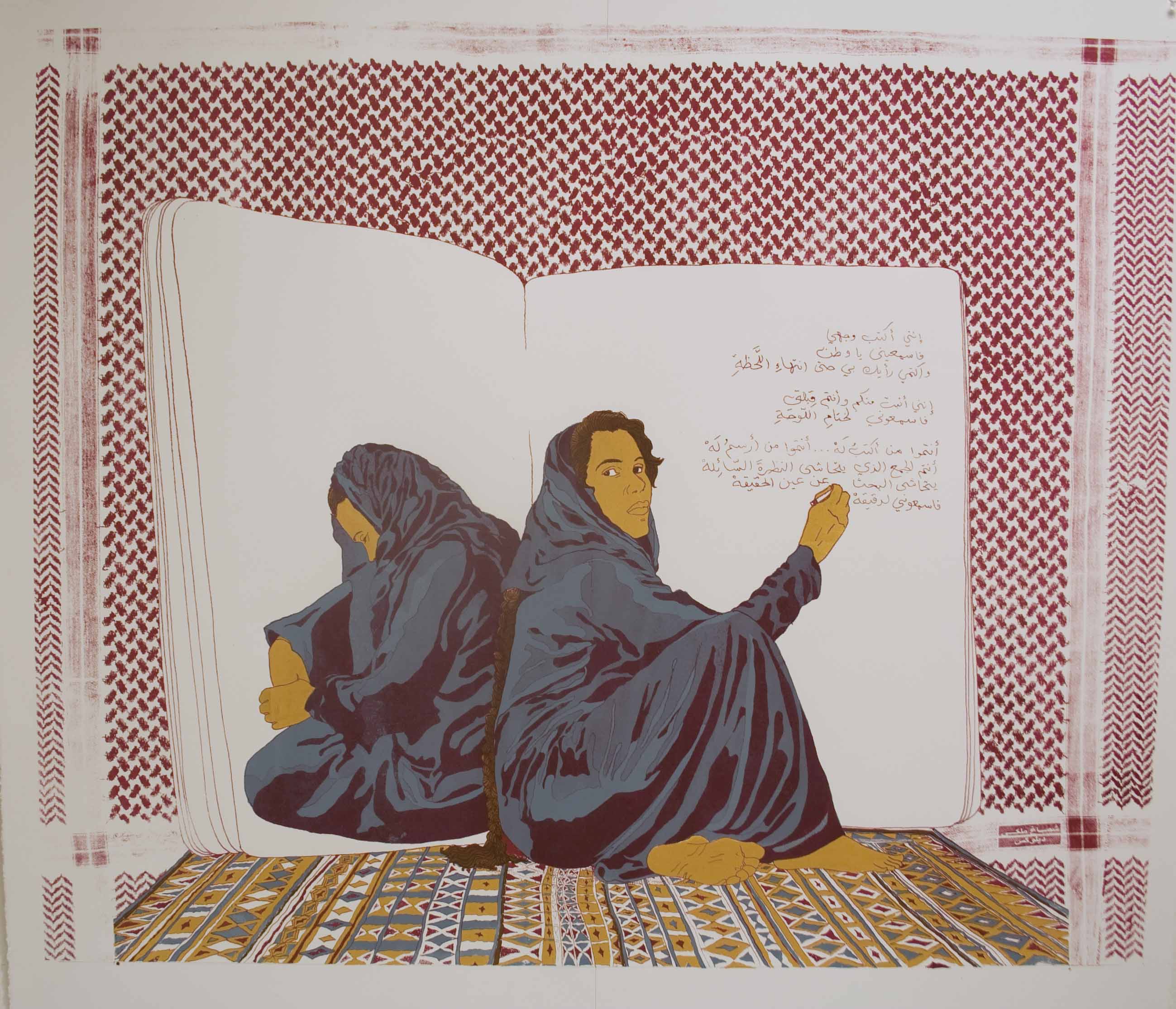
This is a series of screen prints that explore Saudi Arabian women’s lives. I completed two 30-by-36-inch prints. The title was inspired by my niece’s Facebook page post that encouraged women in Saudi Arabia to drive on a certain day as a protest. Although the protest did not happen, the campaign went viral.
The prints progress in a story telling way along with a poem that is written as part of the image. The central element of the prints is a woman facing the viewer and wearing an Abaya. In the first print the protagonist is seated on a Bedouin style woven rug in the foreground. She is turning her head towards the viewer and facing a larger than life open notebook (also facing the viewers). She has already written the first few lines of the poem. Behind the protagonist, and inside the book, there is a slumped down figure looking down and seems like a mirror image of the central figure. The second print the same woman is seen standing by the left side of the book, which now shows more lines of the poem already written. The bent down woman in the book is still in the same place but fainter and there is writing covering her image. I hope to make progressive images showing turning of the pages, more of the poem and fainter shadow image. The protagonist will move in each print to a different place of the image. |
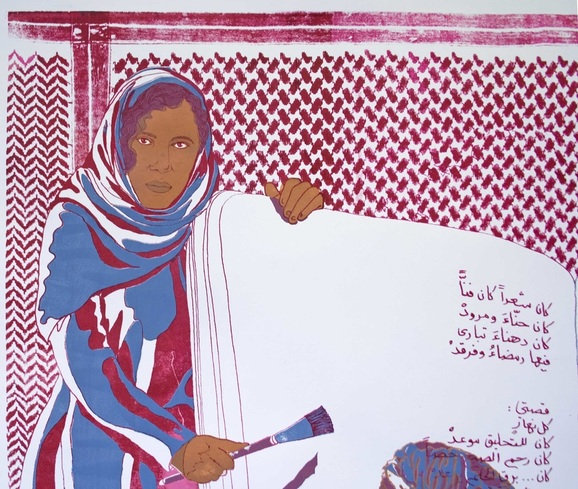
Details of Facebook 2.
|